Gear Ratios First, Lift Second: The Build Order That Actually Makes Your Rig Perform
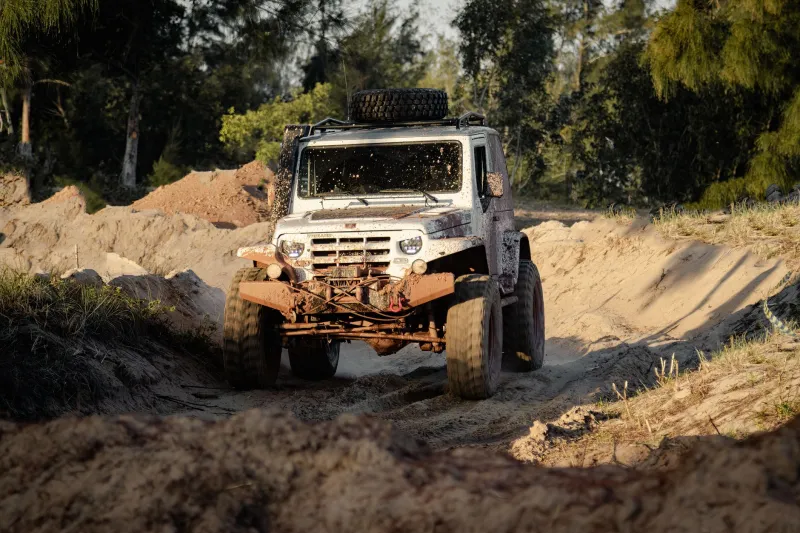
Walk through any trail head parking lot on a Saturday morning—Moab, Ouray, the Rubicon, doesn't matter—and you'll see the same story told over and over in chrome and mud. Lifted trucks, aggressive tires, maybe a snorkel and some rock sliders. What you won't see is a window sticker that says "regeared to 4.88s." And that's kind of the problem.
Gearing doesn't get the Instagram love that a set of 37s does. You can't really photograph a ring and pinion. But talk to the guys who've been wheeling seriously for ten or fifteen years, and almost every single one of them will tell you the same thing: they wish they'd sorted out their final drive ratio before they did anything else. Not after. Not alongside. Before.
Here's why that order matters more than most people realize.
Your Tires Are Already Changing Your Gearing—Whether You Know It or Not
Every time you bolt on a larger tire, you're effectively changing your final drive ratio. This isn't a metaphor—it's basic math. A taller tire has a larger circumference, which means your drivetrain has to work harder to rotate it through each revolution. Your axle gears were engineered around a specific tire diameter from the factory. The moment you deviate from that, you're asking your engine and transmission to do more work with the same mechanical advantage they had before.
Go from a factory 31-inch tire to a 35 without regearing, and you've essentially made your truck feel like it's permanently towing a trailer uphill. Throttle response gets lazy. Low-speed crawling becomes a negotiation instead of a command. And your engine sits in the wrong RPM range for almost everything you're asking it to do on the trail.
The kicker? Most new builders don't feel this immediately. The truck still moves. It still climbs. It just does it badly, and the damage accumulates quietly.
What "Wrong" Gearing Actually Does to Your Drivetrain
Let's get specific, because vague warnings don't help anyone.
When your gear ratio is too tall for your tire size—meaning the gears aren't numerically high enough to compensate for the added diameter—your engine has to lug. Lugging means low RPM under high load, and that's one of the most punishing conditions you can put an internal combustion engine through. Heat builds. Combustion efficiency drops. Automatic transmissions start hunting between gears trying to find a happy place that doesn't exist.
On the trail, this translates directly to dangerous situations. Throttle input becomes unpredictable. You ask for a little power to ease over a ledge and you get either nothing or a sudden surge. Fine-tuned throttle control—the kind you need for technical rock crawling or navigating loose shale—basically disappears.
Long-term, you're looking at accelerated wear on your transmission, your torque converter if you're running an automatic, and your clutch if you're not. Transfer cases take a beating too, especially if you're leaning on 4-Low to compensate for the power delivery problems that proper gearing would have solved in the first place.
The Numbers You Actually Need to Know
The rule of thumb most experienced builders use is straightforward: for every inch of tire diameter you add over stock, you need a numerically higher axle ratio to keep your drivetrain in a healthy RPM range.
A factory JK Wrangler, for example, came with 3.21 gears and 30-inch tires. Run 35s without touching those ratios and you've turned your rig into a candidate for premature transmission failure. Most builders running 35s on a JK land on 4.10s or 4.56s. Step up to 37s and you're typically looking at 4.88s. The specific number depends on your engine, your transmission, and how you actually use the truck—but the principle holds across platforms.
This math applies whether you're building a Tacoma, a Bronco, a full-size Ram, or a classic FJ40. The relationship between tire diameter and axle ratio is universal.
Why Lift and Tires Get Done First (And Why That's Backwards)
The honest answer is that a lift kit looks cool and feels transformative in a way that a ring and pinion swap doesn't. You bolt on two inches of lift, throw on a set of aggressive all-terrains, and the truck looks completely different. People notice. You notice. It feels like progress.
Regearing is expensive, time-consuming, and invisible to everyone except the guy who drives the truck. A quality regear at a reputable 4x4 shop can run anywhere from $600 to $1,500 per axle depending on your platform and the ratio you're targeting. That's real money, and it produces exactly zero visual change to your rig.
But here's the trap: if you do your lift and tires first and then decide to regear later—which most people eventually do—you're paying for the regear twice. Once when you do it, and once in the form of all the wear and fuel economy loss you accumulated running mismatched ratios in the meantime.
Do it first and you never pay that second cost.
How Gearing Affects Everything That Comes After
This is the part of the conversation that rarely gets enough attention. Your gear ratio doesn't just affect your drivetrain in isolation—it affects every other component decision you'll make going forward.
Proper gearing changes how your transfer case behaves in 4-Low. It changes the effective crawl ratio you can achieve, which in turn affects what kind of locker setup makes sense for your build. It changes your fuel economy baseline, which affects how you think about long-distance trail runs and fuel planning. It even affects brake wear, because a well-geared truck uses engine braking more effectively on descents instead of riding the brakes down every hill.
When your gearing is right, everything downstream of it works better. When it's wrong, you're constantly compensating—with your throttle foot, with your braking, with your recovery gear when the rig runs out of grunt at the worst possible moment.
Build It Right the First Time
There's no shame in having done things out of order. Most of us have. The 4x4 community is full of trucks that got lifted before they got regeared, and plenty of those trucks are still out there having a great time on the trail. But if you're starting a build from scratch, or if you're at a point where you're about to make a major jump in tire size, do yourself a favor and make the gear ratio conversation happen first.
Talk to a reputable 4x4 shop—not just a general mechanic, but someone who actually wheels and understands drivetrain dynamics. Tell them your tire size goals, your platform, and how you plan to use the truck. Let that conversation drive your ratio selection before you spend a dollar on suspension.
The trail doesn't care how your rig looks in the parking lot. It cares whether you've got the mechanical foundation to back it up. Gearing is that foundation. Everything else gets built on top of it.