The Fluid Your Rig Is Burning Through on Every Trail (And Why Most Shops Don't Catch It)
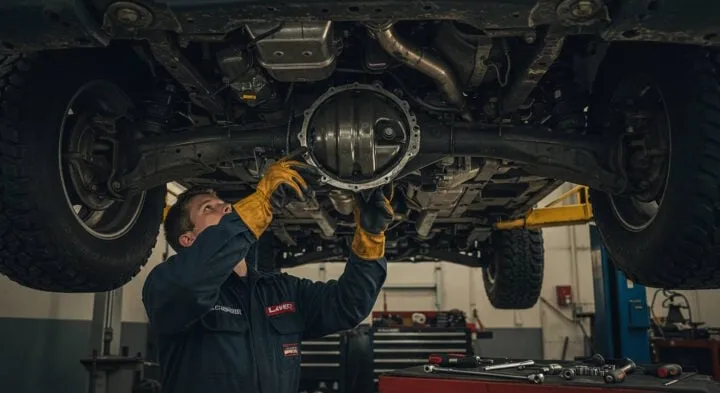
Photo: mechanic changing transmission fluid 4x4 truck off-road maintenance, via www.drivingtests.co.nz
Talk to anyone who's been wheeling seriously for more than a few years and eventually the conversation turns to the same topic: the expensive mistake. The one that happened not because of a bad line choice or a gnarly obstacle, but because something inside the drivetrain quietly gave out after years of hard use that nobody accounted for. More often than not, that story involves a transmission.
I've heard this story from a guy named Marcus who runs trails in the Ozarks every other weekend. He drove a well-maintained — by his words, meticulously maintained — second-gen Cummins for six years. Oil changes on schedule, tires rotated, brakes done right. Then one July weekend, halfway through a creek crossing in the Mark Twain National Forest, his transmission started slipping. Ended up on a flatbed. The diagnosis? Severely degraded fluid that had been heat-cycled past its useful life dozens of times over. The repair was just over $3,800.
"My shop was using the factory service interval," Marcus told me. "But those intervals are built for a guy who drives to work and back. Not for someone who spends six hours in low range every month."
He's not wrong. And he's far from alone.
Why Off-Road Driving Is a Transmission's Worst Enemy
Transmission fluid does several things simultaneously: it lubricates moving parts, transfers hydraulic pressure for gear engagement, cools internal components, and carries away metallic debris from normal wear. On the highway, this system operates within a relatively narrow stress band. Fluid temps stay manageable, gear changes are smooth and infrequent, and the torque loads are predictable.
Off-road, every one of those variables goes sideways.
When you're crawling up a steep grade in low range, your transmission is working at high torque loads for extended periods. When you're descending the same grade using engine braking, the torque converter is doing work it rarely does on pavement. Water crossings introduce contamination risk at every sealed point. And the constant cycling between forward and reverse during technical maneuvering creates heat spikes that degrade fluid chemistry faster than almost anything else.
Modern automatic transmission fluids are sophisticated blends of base oil and additive packages — friction modifiers, anti-wear agents, oxidation inhibitors. Those additives don't last forever. Heat accelerates their breakdown. And once the additive package degrades, the base oil alone isn't doing the job you need it to do.
The Interval Problem
Most factory service manuals include transmission fluid change intervals somewhere between 30,000 and 60,000 miles under "normal" conditions, with a shorter "severe duty" interval buried in a footnote. The problem is that even the severe duty definition — typically including things like trailer towing and commercial use — often doesn't capture the specific stress profile of off-road driving.
A single full day of technical trail driving can put more cumulative stress on a transmission than several months of normal highway use. If you're hitting the trails twice a month, running your fluid to the factory normal interval is a gamble that gets riskier with every trip.
The general consensus among experienced wheelers and dedicated 4x4 shops — not your average quick-lube chain — is to cut standard intervals roughly in half for regular off-road use, and to inspect fluid condition visually and by smell after any particularly demanding outing. Burnt or darkened fluid, or fluid with a distinctly acrid smell, is telling you something important.
What the Trail Veterans Actually Do
I reached out to a few people who've been running trails seriously for a decade or more and asked them about their actual maintenance habits. The answers were consistent in a way that felt like earned wisdom rather than textbook advice.
Deanna, who leads group runs through the Colorado high country with a modified 4Runner, checks her transmission fluid level and condition before every major trip. She uses a temperature-capable scan tool to monitor fluid temps during harder runs and has a personal rule: if she hits sustained temps above 200°F, she's done pushing hard for the day. "The fluid is basically telling you when it's done," she said. "Most people just aren't listening."
Then there's Ray, a longtime overlander based in Southern California who's crossed the Rubicon more times than he can count. He switched to a synthetic transmission fluid several years ago and hasn't looked back. "The heat resistance alone is worth it," he said. "I changed intervals, I went synthetic, and I stopped having transmission anxiety on long runs. It's not complicated — it's just something most people don't think about until they're stranded."
Ray also added an auxiliary transmission cooler to his rig — a relatively inexpensive upgrade that can meaningfully reduce operating temps on sustained climbs. It's the kind of proactive modification that doesn't show up in build photos but quietly saves you thousands over the life of the vehicle.
The Filter Factor
Here's the part that surprises a lot of people: many automatic transmissions have internal filters that are designed to be serviced at the same time as the fluid, but they're frequently skipped during basic fluid changes because accessing them requires dropping the pan. Some shops skip this step to save time. Some owners don't know to ask.
On an off-road vehicle, a clogged or degraded transmission filter restricts fluid flow at exactly the moments when flow matters most — under high load, during heat spikes, when the system is working hardest. If you're doing a proper fluid service, insist on the filter. It's usually a modest additional cost and a significant reliability upgrade.
Treating Maintenance as Adventure Insurance
There's a mindset shift that separates the people who wheel for decades from the ones who have a great few years followed by an expensive lesson. It's the understanding that maintenance isn't a chore — it's the thing that makes the next adventure possible.
Your transmission doesn't care how capable your suspension is or how aggressive your tires are. It's doing physics on every run, converting engine torque into wheel motion under conditions it was never entirely designed for. The fluid inside it is the buffer between that mechanical reality and a very bad day on a very remote trail.
Change it more often than your manual says. Go synthetic if you're running hard. Add a cooler if you're regularly in the mountains or doing extended low-range work. And pull the pan when you do it.
Marcus would tell you the same thing. He's got a new transmission now — and a new service schedule to go with it.