Drivetrain Death by a Thousand Miles: Reading the Wear Signs Before Your Rig Leaves You Stranded
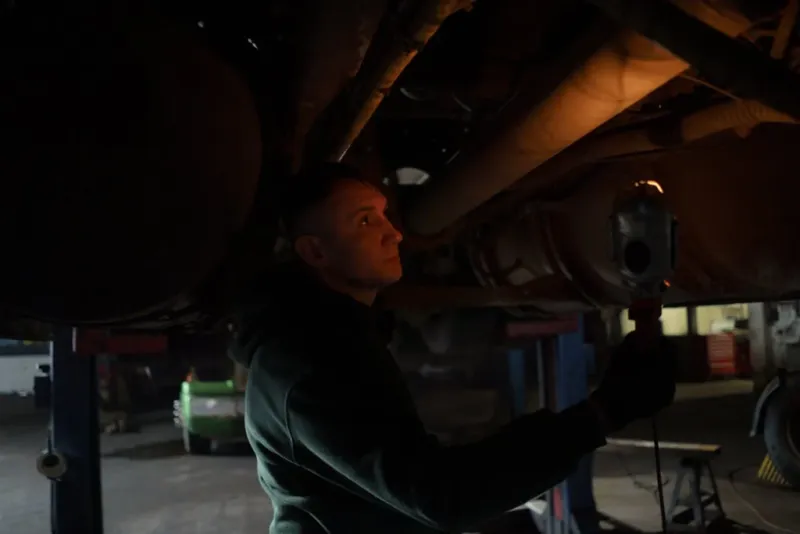
Photo: mechanic inspecting 4x4 truck differential axle off-road garage, via spcdn.shortpixel.ai
There's a particular kind of silence that falls over a trail group when someone's rig makes that sound. You know the one—a clunk, a grinding moan, or a sudden pop that doesn't belong. Nine times out of ten, it's the drivetrain telling you it's been trying to get your attention for a while. The problem is, most of us don't speak drivetrain until it's already too late.
We dug into this with a handful of experienced off-road mechanics and a few NKR community members who've pushed their trucks and SUVs hard enough to learn some expensive lessons. What came back was a clear picture: drivetrain failure on the trail is almost never sudden. It's the result of wear patterns that develop slowly, quietly, and in places most weekend warriors never think to check.
The Transfer Case: Your Four-Wheel Drive's Beating Heart
The transfer case is the piece of hardware that makes your four-wheel drive system actually work. It splits power between your front and rear axles and takes on serious stress every time you engage 4-Lo on a rock crawl or power through deep mud. The problem is that most people only interact with it by turning a knob or pulling a lever—and never actually look at it.
Mike Hensley, a drivetrain specialist out of Knoxville, Tennessee, who's been wrenching on 4x4s for over two decades, put it plainly: "Transfer cases fail in patterns. The first thing I look for is fluid condition. If you pull that drain plug and the fluid looks like chocolate milk or has a burnt smell, you're already dealing with internal wear. Metal particles suspended in the fluid mean gears and chains are eating themselves."
The chain-driven transfer cases found in a huge number of popular rigs—think late-model GM trucks, Jeep JKs, and Ford Explorers—are especially vulnerable to chain stretch. A stretched chain slaps around internally, and the early symptom is a subtle vibration at highway speeds that gets worse under load. Many owners chalk this up to a tire balance issue. It's not.
What to check:
- Fluid condition and color at every oil change interval (or every 30,000 miles minimum)
- Any shudder or hesitation when shifting between 2H, 4H, and 4Lo
- Vibration that increases when the transfer case is under load (climbing grades, towing)
- Fluid leaks around the front and rear output seals
Differentials: The Wear You Can Hear If You Know What You're Listening For
Front and rear differentials are constantly working to manage the speed differences between your wheels—and on the trail, those differences are extreme. Articulation, side-hilling, and wheel spin all put unique stress on ring and pinion gears, spider gears, and carrier bearings in ways that normal street driving simply doesn't.
Carrie Odom, an overlander from Colorado who runs a heavily modified 4Runner, discovered her rear differential was failing on a trip through the San Juan Mountains. "I started hearing this low howl from the rear end under deceleration. I thought it was a wheel bearing. By the time I got home and had it looked at, the pinion bearing was nearly gone and the ring gear had visible pitting. Another hundred miles and I would've lost the rear axle entirely."
Pinion bearing wear is one of the most common differential failures in rigs that see regular trail use, and the howl Carrie described is textbook. Importantly, the sound changes with speed and load rather than staying constant—a key difference from tire noise.
Limited-slip and locking differentials add another layer of complexity. Clutch-pack LSDs degrade over time, especially if the wrong fluid is used or fluid changes are skipped. A chattering sound during low-speed turns in a parking lot is a dead giveaway that your LSD clutch packs are worn.
What to check:
- Howling or whining that changes pitch with vehicle speed
- Clunking when transitioning from acceleration to deceleration (worn backlash)
- Chattering in turns (LSD clutch pack wear)
- Fluid leaks around the pinion seal and axle tube seals
- Fluid condition—same rules apply as the transfer case
Axle Shafts: The Silent Casualties of Hard Wheeling
Axle shafts are the unsung workhorses of your drivetrain, and they fail in ways that are often completely invisible until the moment they let go. Solid front axle rigs—your classic Jeep Wranglers, older Toyota Land Cruisers, and first-gen Tacomas—use U-joints at the axle shaft ends, and those joints take a beating at full steering lock under power.
Tom Briggs, who runs a Jeep TJ build and leads trail runs in the Ouachita National Forest in Arkansas, has seen more than a few U-joint failures in his group over the years. "Most guys don't grease their front axle U-joints nearly often enough. I'm talking every five to six trail runs minimum if you're doing anything serious. A dry U-joint develops wear on the needle bearings fast, and the first sign is a slight vibration or clicking at full lock. Ignore that and you'll be walking."
IFS (independent front suspension) rigs use CV axles instead, which carry their own failure modes. CV boots crack and tear from trail debris and temperature cycling, and once the grease is gone, the joint deteriorates rapidly. A clicking sound during tight turns is the classic warning—don't dismiss it.
Axle shaft twist and fatigue cracking are less common but worth knowing about, especially on rigs running larger tires and lockers without upgrading the shafts. The stress concentrations at the spline ends are where fatigue cracks typically initiate.
What to check:
- U-joint play (grab the driveshaft and check for movement—there should be none)
- Clicking or popping during turns (CV joints)
- Cracked or torn CV boots
- Grease contamination or absence around U-joint caps
- Visible cracks or deformation at axle shaft spline ends (requires pulling the axle)
Your Pre-Trail Diagnostic Checklist
Pull this out before your next run and spend 20 minutes underneath your rig. It's a lot easier than getting winched off a trail.
- Check all drivetrain fluids—transfer case, front diff, rear diff. Look for color, consistency, and metallic contamination.
- Inspect all seals visually—pinion seals, axle tube seals, transfer case output seals. Any weeping or active leaking gets fixed before the trail.
- Grab and wiggle all driveshafts—check for U-joint play at both ends of each shaft.
- Inspect CV boots on IFS vehicles—cracks, tears, or missing clamps mean you're running on borrowed time.
- Listen during a slow parking lot figure-eight—any clicking, chattering, or grinding is a flag.
- Check for play at the wheels—grab each wheel at the 12 and 6 o'clock positions and rock it. Excessive play can indicate wheel bearing or axle bearing wear.
- Note any vibrations on the road—document when they occur (speed, load, turning) and have them diagnosed before the next trail day.
Don't Wait for the Trail to Tell You
The rigs that hold up run after run aren't necessarily built tougher—they're maintained smarter. Drivetrain wear is predictable, progressive, and almost always catchable before it becomes catastrophic. The mechanics and wheelers we talked to all said the same thing: the guys who get stranded are the ones who wait for a symptom to become a problem before they pay attention.
Your drivetrain is trying to talk to you. Learn the language, and you'll spend a lot more time on the trail and a lot less time waiting for a tow.