Wheeling Alone on Your Own Terms: A Real-World Guide for Solo Female Off-Roaders
Photo: Internet Archive Book Images, No restrictions, via Wikimedia Commons
Kayla Reyes didn't grow up wrenching on trucks. She didn't have a dad who took her mudding on weekends or a crew of buddies who showed her the ropes. What she had was a used Tacoma, a YouTube rabbit hole, and a stubborn refusal to wait around for someone else to take her to the places she wanted to go. Three years later, she's run trails in Moab, the Ouachitas, and the Ozarks — mostly solo, always on her own schedule.
"The first time I aired down and hit a rocky section by myself, I was terrified," she says. "But I also felt more alive than I had in years. Nobody was second-guessing my line choice. Nobody was grabbing the oh-shit handle. It was just me and the trail."
Kayla's story isn't unique anymore — and that's a good thing. The number of women wheeling solo has grown steadily over the past several years, driven by a combination of better online communities, more accessible vehicle platforms, and a cultural shift in who gets to claim the outdoors. But getting there takes more than just showing up at the trailhead. It takes preparation, self-honesty, and a willingness to build skills deliberately.
Know Your Rig Before You Need It
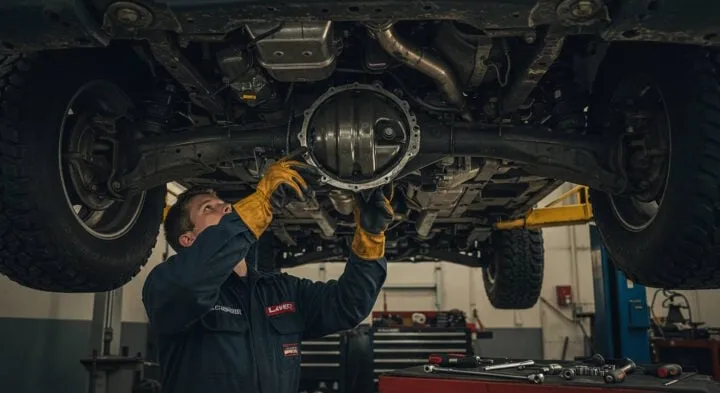
The single most important thing any solo off-roader can do — regardless of gender — is develop a deep, working knowledge of their specific vehicle. That means knowing where every recovery point is, how to engage and disengage 4WD and lockers, what your approach and departure angles actually are, and how to read your rig's behavior when something isn't right.
For women new to off-roading, this knowledge-building phase can feel intimidating because so much of the culture is wrapped up in tribal shorthand. Guys at the trailhead throw around terms like "stuffing bump stops" and "pinion angle" like everyone already knows what they mean. You don't have to know all of it on day one. You do have to know your own truck.
Start simple. Spend a weekend doing nothing but getting comfortable with your vehicle's controls in a safe, low-stakes environment — an empty parking lot, a mild dirt road, a wide-open field. Practice low-speed maneuvering. Practice reversing on a hill. Learn to feel when your tires are about to break traction. This physical familiarity with your machine is the foundation everything else gets built on.
Take a formalized off-road driving course if you can. Organizations like the Overland Expo host clinics, and many 4x4 clubs offer beginner days. Several women-specific programs have emerged in recent years — groups like Chix on the Rocks and Women's Off-Road Experience (WORE) offer clinics specifically designed to create a low-pressure learning environment. These aren't just feel-good spaces. They're places where you can ask questions without feeling like you're performing competence for an audience.
Self-Recovery Isn't Optional
If you're going solo, self-recovery capability isn't a nice-to-have — it's a non-negotiable. The good news is that the core recovery toolkit isn't complicated, and learning to use it is well within reach for anyone willing to practice.
At minimum, solo trail rigs should carry: a quality kinetic recovery rope, a set of tree-saver straps, D-shackles, a hi-lift jack with a base plate, a traction board set (Maxtrax or similar), and a portable air compressor. A winch is a significant upgrade if your budget allows — a mid-size electric winch rated at 9,500 to 12,000 lbs is appropriate for most full-size trucks and SUVs.
Having the gear is step one. Knowing how to use it alone is step two, and it's a step a lot of people skip. Practice deploying your traction boards in your own driveway. Run through a simulated winch-out scenario in a safe area before you need to do it under stress on a remote trail. A hi-lift jack is genuinely dangerous if you've never used one — watch instructional videos, then practice the technique before your life depends on it.
"I practiced getting unstuck in my own backyard," laughs Danielle Morse, who runs a lifted Jeep Gladiator out of Colorado. "My neighbors thought I was losing my mind. But the first time I got stuck on a trail in the San Juans alone, I wasn't panicking. I knew exactly what to do."
Route Planning and the Art of Honest Assessment
Solo off-roading demands a more conservative approach to route selection than group wheeling — not because you're less capable, but because the margin for error is genuinely smaller. When you're alone, there's no one to help you if a recovery goes sideways, no second set of eyes on a sketchy line, and no one to go for help if something goes seriously wrong.
This isn't a reason to stay home. It's a reason to plan deliberately.
Before any solo run, research the trail thoroughly. Apps like onX Offroad and Gaia GPS let you download detailed trail maps for offline use — essential in areas with no cell service. Check recent trail reports on forums and Facebook groups specific to your region. Call the local ranger district if you're uncertain about current conditions. Note the nearest trailhead with cell service, the nearest hospital, and any sections of the route that are known to be technically demanding.
File a trip plan with someone you trust. Tell them your planned route, your expected return time, and what to do if they haven't heard from you by a specific hour. This isn't being dramatic — it's basic backcountry protocol, and it applies to everyone.
Be honest about your current skill level. There's a difference between pushing your limits with a group who can back you up and pushing your limits alone. Solo trips are a great place to consolidate skills you've already developed, not necessarily the place to attempt terrain you've never navigated before.
Handling the Social Dynamics on the Trail
Let's be real: the off-road community is predominantly male, and while it's become significantly more welcoming in recent years, solo women on the trail still occasionally encounter condescension, unsolicited advice, or flat-out skepticism about their capabilities. How you handle that is entirely your call.
Many experienced solo female wheelers develop a straightforward approach: be confident, be prepared, and let your driving speak for itself. You don't owe anyone an explanation of your qualifications. You don't need to prove anything to a stranger at the trailhead. Politely declining "help" you don't need is a complete sentence.
At the same time, the off-road community has a long tradition of genuine trail camaraderie that's worth leaning into. Most people out there are good-faith enthusiasts who'd help anyone in a jam, regardless of gender. Building relationships in local clubs and online communities — particularly women-focused groups — creates a network that makes solo adventuring safer and more enjoyable.
Follow accounts like @she_explores, @girlsthatroam, and region-specific women's overlanding groups on Instagram and Facebook. These communities share trail beta, organize group runs, and provide a space where your experience is centered rather than treated as an anomaly.
The Mental Game
Confidence on the trail is a skill, not a personality trait. It gets built through repetition, through small wins, and through learning to trust your own judgment over time. Every trail you complete solo deposits something into that account. Every skill you practice and master makes the next challenge feel more manageable.
There will be moments of doubt. There will be lines that make your heart rate spike and recoveries that feel like they take forever. That's part of it — for everyone. The difference between a nervous driver and a confident one usually isn't talent. It's experience, and experience is just time plus miles.
Get the miles. Go find your trails. The backcountry doesn't care who you are — it just asks that you show up prepared. Do that, and it belongs to you just as much as anyone else.